Everything you need to study No-Limit Hold'em, free and without an account: preflop charts, calculators, lessons with worked hands, and a glossary of the words players use.
Learn the starting ranges for your games from the charts.
Read the lesson for the spot that costs you the most.
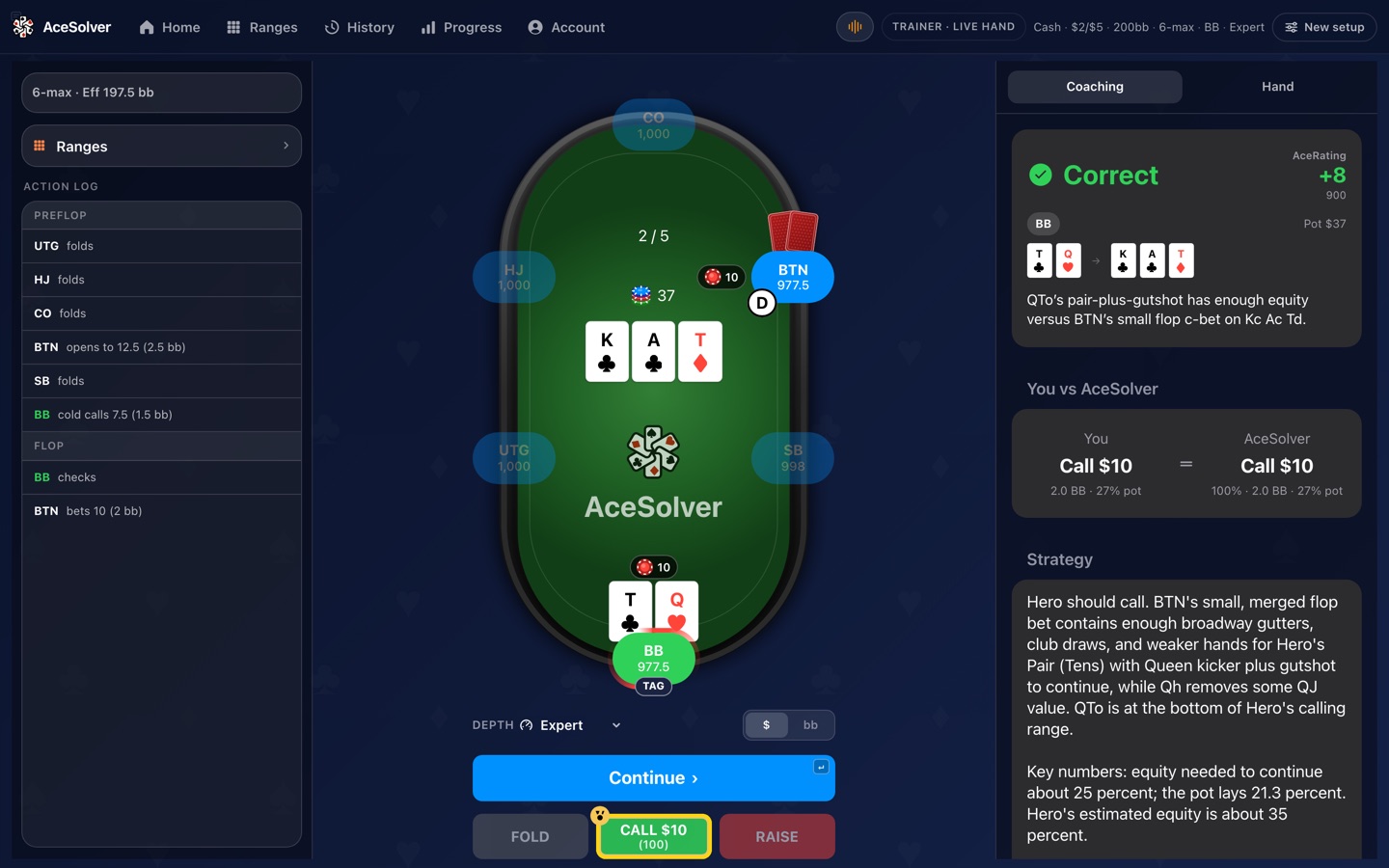
Practice the same spots in the trainer, with coaching on every decision.
The trainer after a decision: your play, the solver's play and why.
From a coaching session
Questions players ask our coaches
Four questions a tournament player sent our coaching team, with the short answers. The full sheet has the tables and worked examples.
How much should I raise to isolate limpers?
In position, raise to 3bb plus 1bb per limper: 4, 5 and 6bb against one, two and three limpers. Out of position, add 1bb more: 5, 6 and 7bb. Against players who call too much, go 1bb bigger with a tighter, value-heavy range. At 20bb or less, a raise that size commits about a third of your stack, so an all-in, a smaller raise or a fold can be better.
What share of the pot should I bet for value, and for a bluff?
Use the same size for both. Choose the size from the board and the street, then decide which value hands and which bluffs bet it, so the size never gives your hand away. As a starting point: 25 to 33% on dry flops that favour the raiser, 50 to 75% (or a check) on connected flops, 50 to 75% on the turn, 25 to 50% for thin river value and 75% or more on a polarized river.
When should I continuation bet?
Start from the board, not your hand. On flops that favour your range, such as K-7-2 or a dry paired board like 8-8-3, bet small (25 to 33%) and often when heads-up. On low connected boards like 6-6-5 or 9-8-6, which hit the Big Blind's range, check more often and bet bigger with strong value and good draws. In multiway pots, c-bet much less often.
When should I call a bet after the flop?
When your equity against the bettor's range beats the price. Required equity = amount to call ÷ final pot after your call: 20% against a third-pot bet, 25% against half pot, 28.6% against two thirds and 33.3% against pot. There is no minimum hand: ace-high can call a small bet and top pair can fold to a very strong range. Count only clean outs, and near the money in a tournament ask for more equity when the call risks your tournament.
 Free · No account needed