Multiway poker solver for pots with up to 10 players
AceSolver analyzes multiway pots with up to 9 opponents, preflop and postflop, and explains the best play in plain language. You see the balanced play and the exploit against the players actually in the pot, so you understand why a hand that is an easy bet heads-up becomes a check four-way.
What changes when a third, fourth or fifth player is in the pot
Most of what players learn from heads-up solver output breaks in multiway pots. The full strategy is in our guide to multiway pots; here are the three changes that cost the most, with the arithmetic.
1. Bluffs have to get through everyone
A bet of 3/4 pot risks 0.75 to win 1, so as a pure bluff it needs folds 0.75 / 1.75 = 42.9% of the time. Say each opponent folds 60% of the time and, to keep it simple, they decide independently:
| Opponents | Everyone folds | Bluff needs | Result |
|---|---|---|---|
| 1 | 60% | 42.9% | Profitable |
| 2 | 0.6 × 0.6 = 36% | 42.9% | Loses money |
| 3 | 0.6³ = 21.6% | 42.9% | Loses badly |
Real players do not fold independently (the last player to act often defends wider once the others have folded), but the direction holds: pure bluffs shrink fast as players are added, and bets lean toward value and strong draws.
2. Hand values compress
Against more opponents, every hand wins less often. Here is all-in preflop equity against random hands (our Monte Carlo, 20,000 deals per cell, rounded):
| Hand | vs 1 | vs 2 | vs 4 |
|---|---|---|---|
| A♠A♥ | 85% | 73% | 56% |
| K♠Q♠ | 63% | 47% | 32% |
| T♥9♥ | 54% | 39% | 26% |
| Fair share | 50% | 33% | 20% |
Aces drop from 85% to 56%. One pair, even a good one, is much more often beaten when five players see the flop, which is why top pair with a weak kicker turns from a value bet into a check. Notice the other side too: T♥9♥ is 4 points above its fair share heads-up (54% against 50%) and 6 points above it five-way (26% against 20%). Hands that make straights and flushes gain relative value when more players pay them off.
3. Your price changes when someone calls before you
Heads-up, facing a bet of 10 into 20, you call 10 to win a final pot of 40: you need 10 / 40 = 25% equity. If one player has already called, the final pot is 50 and you need 10 / 50 = 20%. The price is better, but the caller ahead of you usually has a real hand, so your equity drops too. Overcalling well means weighing both, and that is exactly the kind of spot a heads-up chart cannot answer. Check any price with the pot odds calculator.
Why multiway solving is rare
A solver has to track every player's range (up to 1,326 starting combinations each) and every possible sequence of actions on every street. Each added player multiplies the sequences, so memory and solving time climb steeply. As of October 2026, from each product's public pages: PioSOLVER and GTO+ solve heads-up postflop spots, and GTO Wizard offers custom three-way postflop solving on its top plan, with an expansion to 9 players announced (see the full comparison for sources).
What AceSolver does in a multiway pot
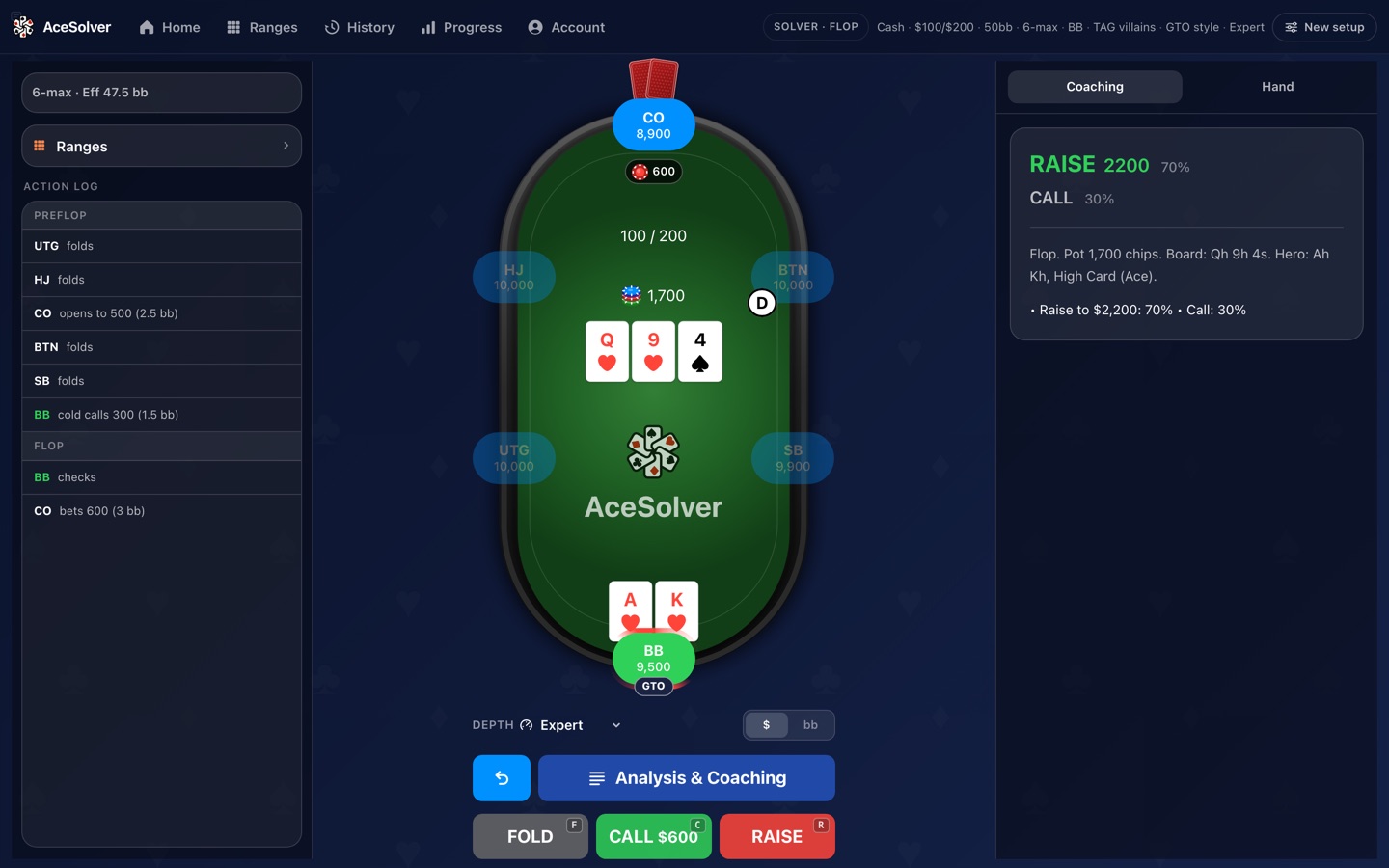
- Real multiway evaluation, up to 9 opponents. On the exact spot, it works through the poker math, including your hand strength, every out, the pot odds and the stack-to-pot ratio, with every player still in the hand counted.
- A clear answer with a recommended mix. For example "raise 70%, call 30%", followed by why, in plain language, and what to do next time.
- The balanced play and the exploit, both explained. Tell it the opponents are a Calling Station and a NIT, and it explains how the best play shifts against those two players.
- Cash and tournaments. Cash games with rake, and tournaments with ICM pressure, heads-up to 10 players.
- Practice, not just reading. The same evaluation coaches you in the trainer, where you play multiway hands yourself against 15 opponent styles.
What it does and does not do
AceSolver is an on-demand analysis and coaching tool. It is honest to say where that differs from a desktop solver:
| AceSolver does | AceSolver does not |
|---|---|
| Analyze the exact spot you enter, with up to 9 opponents | Build a full game tree you can browse node by node |
| Explain the best play and the reasoning in plain language | Let you node-lock a player's strategy or export solved trees |
| Adjust the explanation to opponent styles (Calling Station, Maniac, NIT and more) | Run aggregated reports across every flop |
| Show preflop solver range charts for cash and tournaments | Apply ICM to the preflop charts, which are chip-based; ICM pressure is handled in the hand analysis |
| Run on iPhone, iPad, Android and the web | Run during a live or online game: it is built for study between sessions |
If you want to build trees and node-lock, use a desktop solver. If you want to understand what to do in the four-way pots you keep playing, and practice them, that is what AceSolver is for.
Frequently asked questions
Why are multiway pots so hard to solve?
Every extra player adds another range to track and multiplies the number of action sequences on every street. The game tree grows very fast. As of October 2026, PioSOLVER and GTO+ solve heads-up postflop spots, and GTO Wizard offers custom three-way postflop solving on its top plan.
How many players can AceSolver handle?
Real multiway evaluation with up to 9 opponents, so any pot from heads-up to a full 10-handed table, preflop and postflop, in cash games and tournaments.
Is AceSolver a replacement for a desktop solver?
Not for every job. It analyzes the exact spot you give it and explains it in plain language. It does not build a full game tree you can browse, node-lock or export, and it does not run aggregated reports across every flop. If that is how you study, a desktop solver is the right tool.
Is the multiway solver free?
Preflop analysis in the Solver is unlimited and free, and you get one full hand analysis every day, multiway postflop included, with no card. Full access is $24.99 per month or $199 per year.