The poker trainer that coaches every decision
AceSolver is a poker trainer where you play real hands against opponents who play like real players, then get coached on every decision you made. You see the best play, the reasoning behind it and what to do next time, in cash games and tournaments, heads-up to 10 players.
How a training session works
- Pick a spot. Choose the game you really play: cash or tournament, how many players, your seat, your stack and who sits at the table.
- Play the hand. You make every decision yourself, preflop to river, against opponents who play like the players you meet.
- Get coached. After each decision you see the best play, the reasoning behind it and what to do next time. Your choice is graded and your AceRating moves with it.
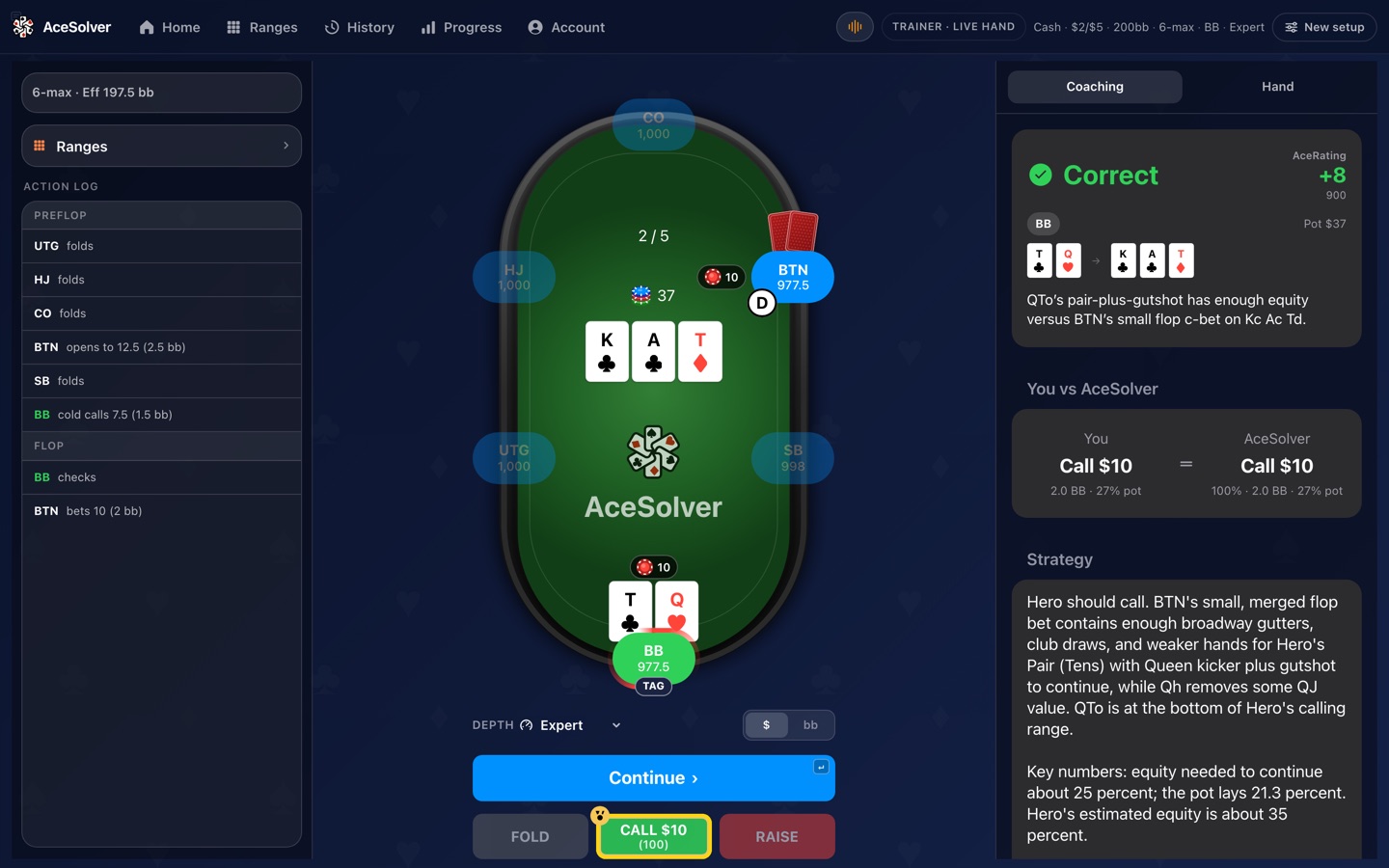
Here is what that looks like in the hand pictured above. Hero defends the big blind with Q♥T♣ in a $2/$5 game, the flop comes K♣ A♣ T♦, and the button bets $10 into $27. The coaching works it out: Hero calls $10 into a final pot of $47, so the price alone asks for 10 / 47 = 21.3% equity, and the coaching puts the equity needed to continue at about 25%, higher than the price because out of position Hero will not realize all of that equity. Hero holds a pair of tens plus a gutshot to a straight with any jack, estimated at about 35% against a small, wide bet. The coaching recommends calling, using its range and equity-realization estimates, and explains why: the button's small bet includes broadway gutshots, club draws and weaker hands that Hero beats, while Hero's Q♥ removes some of the QJ that already has the straight.
15 opponent styles, from rock-tight to reckless
Real tables are not full of balanced players, so the trainer is not either. Each seat can be given one of 15 styles, or a random draw: a balanced GTO opponent as a baseline, and the 14 below. Each of them plays to a profile you can recognize at a real table, and the VPIP and PFR ranges below are the typical ranges each opponent style is set up to play toward in the trainer. Learning to spot a style from its VPIP (how often it puts money in preflop) and PFR (how often it raises preflop) is half of beating it.
| Style | How it plays | VPIP % | PFR % |
|---|---|---|---|
| NIT | Very tight. Opens a narrow, premium range, 3-bets mostly QQ+ and AK, and folds far too often to real pressure. | 10-15 | 8-12 |
| Rock | Sits and waits. Plays few pots, often limps or flat-calls, almost never bluffs and only stacks off near the nuts. | 12-18 | 3-6 |
| TAG | Tight-aggressive and solid. Value-heavy betting with credible bluffs, c-bets more than average, folds clearly weak hands. | 18-24 | 15-20 |
| ABC Player | Plays the fundamentals. Standard ranges and simple sizes, bets strong hands for value, avoids complicated bluffs. | 18-24 | 14-18 |
| Trapper | Slowplays. Checks and calls with strong hands, keeps pots small early, then raises on a later street. | 18-24 | 12-16 |
| Short-Stacker | A short-stack specialist. Prefers shove-or-fold and low-commitment lines, most at home around 20 to 40 big blinds. | 15-22 | 12-18 |
| Exploitative Pro | A strong player who adjusts: thinner value against callers, more bluffs against players who fold too much. | 20-30 | 17-25 |
| LAG | Loose-aggressive and skilled. Wider opens and 3-bets, barrels several streets, bets thin for value and bluffs big. | 26-32 | 22-28 |
| Glass Cannon | Strikes first and hard, then gives up: c-bets far more than average but folds too often to a raise or a 3-bet. | 24-30 | 20-26 |
| Spewer | Erratic in both directions. Bluffs and hero-calls at the wrong times, with sizes that swing from tiny to huge. | 30-45 | 22-35 |
| Fish | Loose and passive. Plays too many hands, limps often, chases any pair or draw and bets small and inconsistently. | 35-50 | 5-12 |
| Calling Station | Calls far too wide and rarely folds once involved. Rarely raises and rarely bluffs. | 40-60 | 3-8 |
| Maniac | Hyper-aggressive. Opens very wide, 3-bets light, barrels most streets and stays sticky when someone fights back. | 40-55 | 32-45 |
| Whale | A loose gambler. Calls extremely wide, overpays with weak made hands and now and then opens oversized. | 45-70 | 8-18 |
The coaching changes with the opponent. Against a Calling Station you bet thinner for value and bluff less, because the bluff rarely works; against a NIT you steal more and believe big bets. Two guides go deeper: how to beat calling stations and how to play against maniacs.
Train the formats you actually play
- Heads-up to 10 players. Practice the table size you sit at, including multiway pots. PioSOLVER and GTO+ solve heads-up postflop spots; GTO Wizard offers custom three-way postflop solving on its top plan.
- Cash games with rake. Rake changes which marginal hands are worth playing, so it is part of the spot.
- Tournaments with ICM pressure. ICM converts chips into prize equity, which is why a call that wins chips can still lose money near the bubble. Train from the first levels to the final table and learn when survival matters more than chips.
- Difficult boards. Drill paired boards, three-to-a-flush boards and other textures where most players lose the thread.
Before the flop, the trainer uses solver range charts. You can study the same charts on their own, for free: preflop range charts for cash and tournaments, for opening, facing an open, facing a 3-bet and facing an all-in.
See your progress
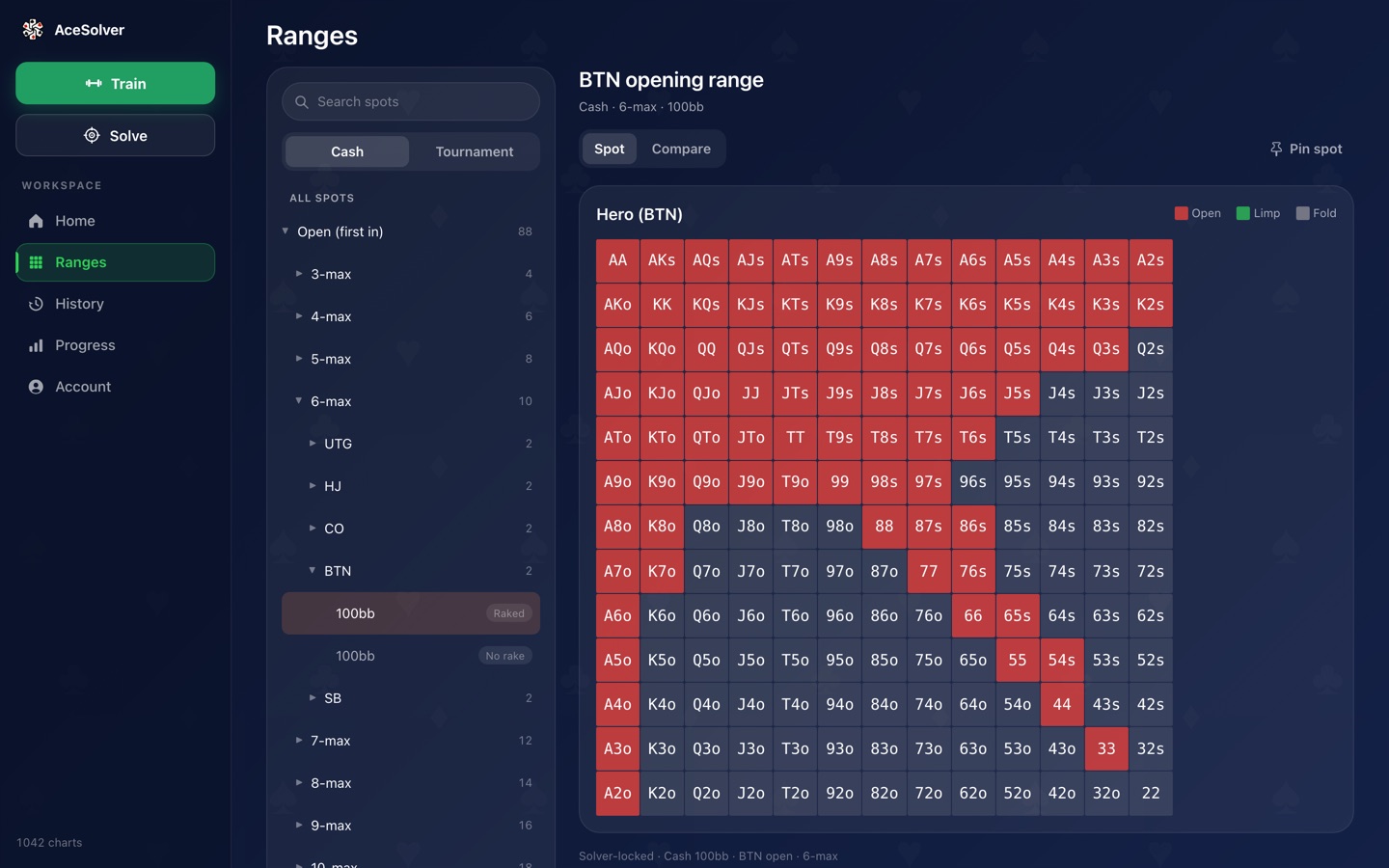
Every graded decision counts. Your AceRating is one number that moves with your decisions, up when you find the right play and down when you miss it. The progress page splits your results into correct, close and wrong, shows your accuracy by position and by street, and keeps every hand in My Hands, so you can replay the spots you got wrong until they become easy.
When you want the why behind one spot
The trainer has a partner: the Solver, where you set up any spot and get a detailed explanation, including real multiway evaluation with up to 9 opponents. Read more on the multiway solver page, or check the math yourself with the free pot odds calculator.
Frequently asked questions
Is the poker trainer free?
Yes, every day. The free plan includes one full hand analysis every day with every feature of the full app, plus unlimited preflop analysis in the Solver and unlimited range charts. No card is needed. Full access is $24.99 per month or $199 per year.
What games can I practice?
No-Limit Hold'em cash games with rake, and tournaments with ICM pressure, from heads-up to 10 players. You choose your seat, your stack and your opponents' styles.
How is this different from a GTO trainer that grades my action?
A grade tells you that you lost value. The coaching tells you why: the best play, the reasoning behind it with the key numbers such as the equity you need and the equity you have, and what to do next time in the same spot.
Can I use the trainer while I play?
No. AceSolver is built for training and hand review between sessions, not for real-time assistance during live or online games.
Which devices does it run on?
iPhone, iPad, Android and the web, on one account and one subscription. Coaching is available in 15 languages.